
VR in the Eye of Nurses: How a Interreg Central Europe Project is Rewiring Medical Training
We’re stepping out of the corporate world to dive deep into VReduMED, a successful Interreg CENTRAL EUROPE project. This MedTech innovation initiative is on a mission to support the education of healthcare professionals through VR (Virtual Reality). No sketchy articles here—just a raw, insightful conversation with people building the future.
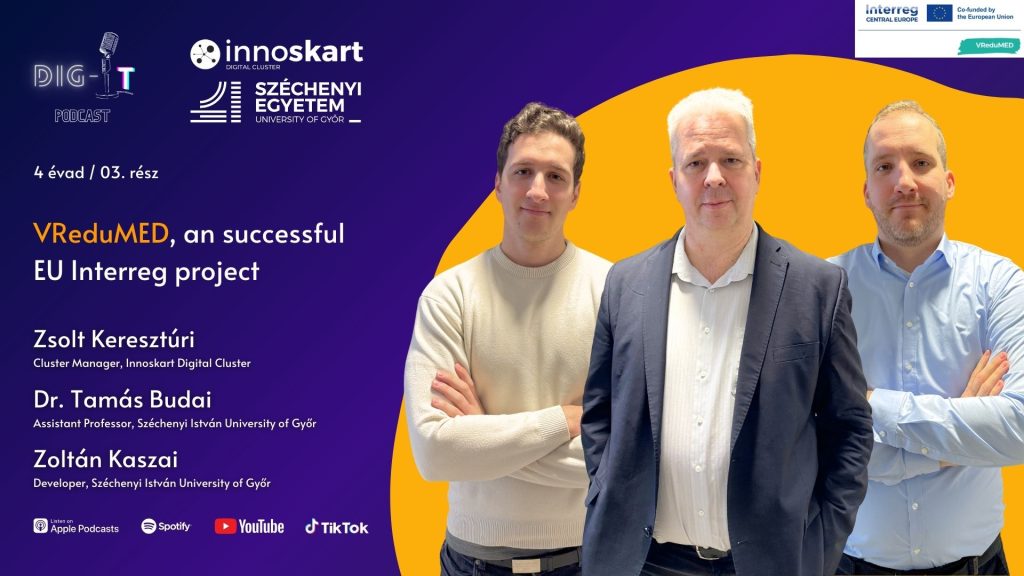
Our fantastic guests were:
- Zsolt Kereszturi, Manager, Innoskart Digital Cluster
- Dr. Tamás Budai, Assistant Professor and CTO at the Center for Digital Developments, Szechenyi István University of Gyor.
- Zoltán Kaszai, VR/AR Developer and team leader at the same center.
So, what happens when you bring together Hungarian tech experts, international hospitals, and nurses with „very strong personalities”? Let’s find out!
The Mission: VR as a Teaching Partner, Not a Replacement
Right off the bat, Tamas set a crucial expectation: this isn’t about replacing hands-on training. When nurses wanted to practice fine motor skills like IV insertions in VR, the team had to be honest. „The technology is not there yet,” explained Tamas. Instead, VReduMED focused on enrichment—using VR to create scenarios that are too risky, too rare, or too logistically messy to practice regularly in real life.
Zoltan’s Code Meets the „Room of Horror”
The conversation got fascinating when Tamas described one of their flagship applications: the „Room of Horror.” Don’t let the name fool you—it’s not a videogame. Their German project partners already used a physical „error room” for final exams, where nursing students must find hidden mistakes in a clinical setup.
„It was a very good candidate to actually put into VR,” Tamas said. Why? Because in VR, you can create infinite room variations, hide different errors, and—crucially—reset everything with a click. Zoltan, who led the development, highlighted how this solved a real problem: „When you do it in the physical world, you need like 20 minutes to prepare the room for the next student.” In VR you can do it in 1 second.
Zsolt’s Personal Connection and the Stress Factor
Zsolt from the Innoskart Digital Cluster (who joined us for the project’s collaborative perspective) shared a powerful personal insight. His daughter is studying to be a nurse. For him, seeing VR applications for training—like a CPR simulation set as a rainy nighttime roadside accident—was a revelation. It meant students could practice high-stakes reanimation without a live patient.
This taps into a core strength of VR, as Tamas elaborated. The technology can „cheat our senses” to elevate stress levels in a controlled way, mimicking the psychological pressure of a real emergency. This kind of emotional preparedness is hard to train with a static dummy.
The Human Glue: Bridging the Jargon Gap
Perhaps the most compelling takeaway was about collaboration. Tamas spoke candidly about the „really healthy discussion and maybe a bit of dispute” with healthcare professionals. It was a constant process of translation—bridging the gap between medical needs and tech possibilities. Furthermore, working with partners from Austria, the Czech Republic, Germany, Slovakia, and Hungary revealed unexpected challenges. They discovered that even the names for basic medical equipment differed between countries, all of which Zoltan’s team had to account for in their multilingual applications.
The Legacy: A Handbook for the Future
As this three-year project wraps up, its knowledge won’t disappear. The team is creating a public handbook and roadmap. This won’t be just a dry user manual. As Tamas described, it’s designed for decision-makers, educators, and MedTech companies, packed with practical advice, adoption statistics, and lessons learned—a true blueprint born from real, gritty, cross-border work.
What’s Next for VR in Healthcare?
We asked our guests to look ahead:
- Tamas is watching the evolution of haptic feedback (think: tactile gloves) and lighter headsets to tackle motion sickness.
- Zoltan, from his developer’s chair, is waiting for more processing power and higher resolution to render incredibly detailed anatomical models.
- The consensus? VR won’t replace the physical world, but it’s becoming an indispensable partner in building more confident, capable healthcare professionals.
Listen to the Full, Uncut Conversation
This blog post only captures highlights. To hear the full discussion—including the business potential of such projects, the differences between the 10 collaborating organizations and our guests’ personal wellbeing routines—listen to the full episode now!
🎧 Listen to DIG-IT Podcast S04E03: VReduMED – The VR Healthcare Training Project
The podcast episode and this blog article provides information about the VReduMED project funded by the Interreg CENTRAL EUROPE programme, as well as its news, events and activities. Our goal is to keep this information timely and accurate at all times. If errors occur and are brought to our attention, we will correct them as quick as possible.
The Interreg CENTRAL EUROPE Managing Authority and Joint Secretariat accept, no responsibility or liability with regard to information provided in this podcast and blog article.
„This podcast episode and the blog article is part of the VReduMED project, co-funded by the Interreg CENTRAL EUROPE programme.”
Discover one of Europe’s most exciting project and be part of the VR experience: https://www.vredumed.eu/
Co-funded by the European Union https://www.interreg-central.eu/projects/vredumed/
Author: Laszlo Szemelyi